- Published on
Board Game Storage for Small Spaces: Keep the Boxes, Find the Pieces
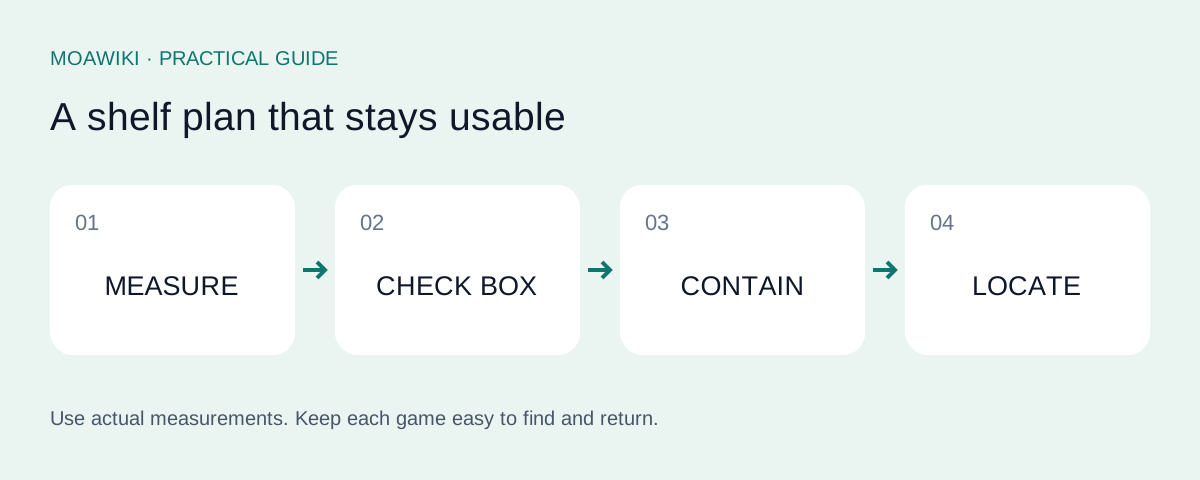
For a small board game collection, start by measuring the usable shelf space and your largest boxes. Keep loose pieces contained, choose a storage orientation for each game, and record where separated components live. A box that fits the shelf but is awkward to remove is not a finished storage plan.
This is a planning guide, not a hands-on comparison of shelves or inserts. The worksheets below are original examples you can copy into your own notes. No purchase or account is required.
1. Measure the opening, not the furniture listing
A cabinet's outside dimensions do not tell you the clearance inside a compartment. Measure between the shelf supports, from the usable front edge to the back, and from the shelf surface to the underside of the shelf above. Check whether a door hinge blocks part of the opening.
Record the dimensions of the closed box in its intended orientation. Include any lid lift caused by an organizer. Leave enough room to grip and remove it; do not treat an exact mathematical fit as a usable fit.
| Location | Clear width | Clear height | Usable depth | Box and orientation | Can I remove it easily? |
|---|---|---|---|---|---|
| Cabinet A | ___ | ___ | ___ | ___ | Yes / No |
| Shelf B | ___ | ___ | ___ | ___ | Yes / No |
| Drawer C | ___ | ___ | ___ | ___ | Yes / No |
For example, a hypothetical compartment measuring 13 inches wide, 13 inches high and 11 inches deep does not fully support a box that extends 12 inches from front to back. Turning it may change which dimension becomes the depth, but check the internal storage before choosing that orientation. These numbers illustrate the method; they are not dimensions of a particular shelf or game.
For a shared shelf, first reserve space for the things that already belong there. Planning only the games can create a storage problem for everything else.
2. Decide which games can stand vertically
Vertical storage makes individual boxes easier to reach, but loose pieces and open trays can move. Flat storage may suit a game whose insert only works lying down. A mixed arrangement is a useful starting point, rather than forcing every game into one orientation.
StorHub's storage guide discusses both approaches, including containing pieces for upright boxes and using short stacks for larger, heavier games. Follow the instructions for your particular game or insert when provided.
Before standing a game on its side:
- Put loose components into suitable bags or closed containers that fit inside the box.
- Check that the board, rulebook and trays sit in their intended places.
- Close the lid without forcing it.
- Support the closed box on a table and gently tilt it toward the intended position.
- Return it flat, open it, and check whether pieces escaped their containers.
Do not shake the box to test it. If components move into a mess, keep that game flat until its internal storage is changed. Avoid pressing rubber bands tightly into fragile cardboard just to make an unsuitable box stand up.
3. Give small card games one address
Small boxes often disappear behind large games. A shallow bin or a designated shelf section can give them a shared home while preserving their individual packaging. Label the outer container rather than attaching permanent labels to collectible boxes.
Check the closed box against the container's inside measurements before buying anything. Card sleeves, unusual card sizes and expansions can change what fits. A container advertised for photographs is not automatically the right size for a card game.
Keep games that need different parts to play separate. If you combine an expansion with the base game, record that choice and retain the rules or component list you still need.
4. Make a location list that helps on game night
A useful list answers “Where is the thing I need?” rather than simply recording ownership. Here is a fictional example:
| Game | Main box | Extra components | Return check |
|---|---|---|---|
| Game A | Shelf A, left | None | Four player bags |
| Game B | Cabinet B, flat | Expansion cards inside base box | Two decks and rulebook |
| Game C | Small-game bin | Score pad in the same bin | Pencil returned |
Copy this blank version:
Game:
Box location:
Orientation: flat / upright
Separate expansion or accessory location:
Component checklist source: rulebook page ___
Missing or replacement pieces:
Last checked:
You can use the template on paper or in a local document. This article does not save entries or sync a collection. If several people share the games, put one agreed copy beside the shelf so updates do not split across multiple lists.
5. Try the arrangement before adding more storage
Choose a small group of frequently played games and give each a fixed location. After the next few game nights, note which boxes are hard to remove, which pieces end up elsewhere, and which containers take too long to repack. Adjust those specific problems before buying organizers for the whole collection.
Keep boxes away from damp locations and direct sunlight, and follow the furniture manufacturer's load and anchoring instructions. This guide does not prescribe a universal shelf capacity or humidity setting.
Frequently asked questions
Should I throw away the original boxes?
You do not need to do that to try this system. Start with measurements, internal bags and a location list. Discarding packaging is difficult to undo and may remove component information or make future resale less convenient.
Is vertical storage always better?
No. The insert, component containment, box condition and access space matter. The tilt-and-check step above helps you decide for an individual game; it is not a guarantee against damage.
What if my collection still does not fit?
Separate regularly played games from those you only need occasionally, then measure the available dry storage locations. Rotating a few games can be tested without immediately buying a larger shelf. Keep the location list current so “stored elsewhere” does not mean lost.
Can I use this for a move?
The list can help track locations, but shelf storage is not transport packaging. Boxes that remain tidy on a shelf may need additional protection during a move.
Reference and further reading
Reviewed November 21, 2026.
- StorHub — Gaming and board game collection storage, practical storage guidance; not an endorsement of a storage service.
- Board Games Guide — Small-apartment storage, further discussion of shelf dimensions and access.
For another household inventory workflow, see the freezer inventory guide and printable sheets.